



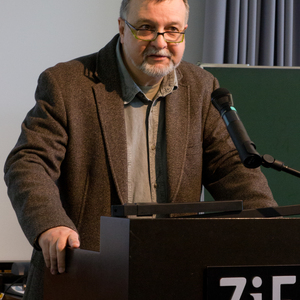

Gerd Bohner
- SPN Mentor
I am Professor of Social Psychology and Experimental Gender Research at the University of Bielefeld, Germany. My research interests include social cognition and motivation, attitudes and persuasion, social influence, stereotyping, and the role of affect and other subjective experiences in social judgment. Some applications and content areas I have worked with are advertising, law, and sexual aggression.
I received my first degree in Psychology (Dipl.-Psych.) in 1986 and my PhD in 1990, both from the University of Heidelberg. Since 1988 I have held academic positions at the University of Mannheim (Lecturer, 1988-1998); New York University (Feodor Lynen Fellow, 1991-1992); University of Würzburg (Deputy Professor, 1998); University of Kent (Senior Lecturer to Professor, 1998-2001); University of Bielefeld (Professor, 2001-present).
From 2007 to 2011, I served as founding editor-in-chief and later associate editor of the journal Social Psychology.
From 2015 to 2017, I was associate editor of the European Journal of Social Psychology.
From 2016 to 2019, I served as acting editor-in-chief of the International Journal of Conflict and Violence, a fully on-line open-access journal (see http://www.ijcv.org/index.php/ijcv ).
Primary Interests:
- Aggression, Conflict, Peace
- Applied Social Psychology
- Attitudes and Beliefs
- Emotion, Mood, Affect
- Evolution and Genetics
- Gender Psychology
- Intergroup Relations
- Judgment and Decision Making
- Person Perception
- Persuasion, Social Influence
- Prejudice and Stereotyping
- Social Cognition
Research Group or Laboratory:
Note from the Network: The holder of this profile has certified having all necessary rights, licenses, and authorization to post the files listed below. Visitors are welcome to copy or use any files for noncommercial or journalistic purposes provided they credit the profile holder and cite this page as the source.
Image Gallery

Journal Articles:
- Abrams, D., Viki, G. T. N., Masser, B., & Bohner, G. (2003). Perceptions of stranger and acquaintance rape: The role of benevolent and hostile sexism in victim blame and rape proclivity. Journal of Personality and Social Psychology, 84, 111-125.
- Bohner, G., & Dickel, N. (2011). Attitudes and attitude change. Annual Review of Psychology, 62, 391-417.
- Bohner, G., & Schapansky, E. (2018). Law students' judgments of a rape victim's statement: The role of displays of emotion and acceptance of sexual aggression myths. International Journal of Conflict and Violence, 12, 1-13.
- Bohner, G., & Schlüter, L. E. (2014). A room with a viewpoint revisited: Descriptive norms and hotel guests' towel reuse behavior. PLOS ONE, 9(8), e104086. https://doi.org/10.1371/journal.pone.0104086.
- Bohner, G., & Weinerth, T. (2001). Negative affect can increase or decrease message scrutiny: The affect interpretation hypothesis. Personality and Social Psychology Bulletin, 27, 1417-1428.
- Bohner, G., Ahlborn, K., & Steiner, R. (2010). How sexy are sexist men? Women’s perception of male response profiles in the Ambivalent Sexism Inventory. Sex Roles, 62, 568-582.
- Bohner, G., Bless, H., Schwarz, N., & Strack, F. (1988). What triggers causal attributions? The impact of valence and subjective probability. European Journal of Social Psychology, 18, 335-345. https://doi.org/10.1002/ejsp.2420180404
- Bohner, G., Boege, R. M. J., Glaser, T., Klempel, L., & Linne, R. (2021). Saving versus deleting thoughts affects focal and lateral attitude change. International Journal of Social Psychology, 36(2), 300-329.
- Bohner, G., Echterhoff, G., Glaß, C., Patrzek, J., & Lampridis. E. (2010). Distress in response to infidelities committed by the partners of close others: Siblings versus friends. Social Psychology, 41, 223-229.
- Bohner, G., Einwiller, S., Erb, H.-P., & Siebler, F. (2003). When small means comfortable: Relations between product attributes in two-sided advertising. Journal of Consumer Psychology, 13, 454-463.
- Bohner, G., Siebler, F., & Schmelcher, J. (2006). Social norms and the likelihood of raping: Perceived rape myth acceptance of others affects men's rape proclivity. Personality and Social Psychology Bulletin, 32, 286-297.
- Bohner, G., Weiss, A., Schirch, C., Zöllner, L., Lipińska, A., Sempere, M.-J., & Megías, J. L. (2022). AMMSA-21: A revised version of the Acceptance of Modern Myths About Sexual Aggression Scale in English, German, Polish, and Spanish. International Journal of Social Psychology, 37(3), 460-491.
- Diehl, C., Rees, J., & Bohner, G. (2012). Flirting with disaster: Short-term mating orientation and hostile sexism predict different types of sexual harassment. Aggressive Behavior, 38, 521-531.
- Diehl, C., Rees, J., & Bohner, G. (2018). Predicting sexual harassment from hostile sexism and short-term mating orientation: Relative strength of predictors depends on situational priming of power versus sex. Violence Against Women, 24, 123-143.
- Gerger, H., Kley, H., Bohner, G., & Siebler, F. (2007). The Acceptance of Modern Myths About Sexual Aggression Scale: Development and validation in German and English. Aggressive Behavior, 33, 422-440.
- Glaser, T., Dickel, N., Liersch, B., Rees, J., Süssenbach, P., & Bohner, G. (2015). Lateral attitude change. Personality and Social Psychology Review, 19, 257-276.
- Glaser, T., Hellmann, J., Pilz, N., & Bohner G. (2023). Left and right in space and politics. Social Cognition, 41(1), 41-66.
- Grau, I., & Bohner, G. (2014). Anchoring revisited: The role of the comparative question. PLoS ONE 9(1), e86056.
- Linne, R., Glaser, T., & Bohner, G. (2024). Lateral attitude change: Displacement effects as a reaction to blatant social influence. Current Psychology, 43, 20691-20697.
- Megías, J., Thon, P.-R., Siebler, F., & Bohner, G. (2025). Attitudes toward prostitution in Norway, Spain, and Germany: Association with the legal context and susceptibility to persuasion. Scandinavian Journal of Psychology, 66(2), 253-265.
- Milesi, P., Süssenbach, P., Bohner, G., & Megías, J. L. (2020). The interplay of modern myths about sexual aggression and moral foundations in the blaming of rape victims. European Journal of Social Psychology, 50(1), 111-123.
- Papendick, M., & Bohner, G. (2017). Passive victim – strong survivor? Perceived meaning of labels applied to women who were raped. PLOS ONE, 12(5), e177550.
- Schwarz, N., Bless, H., & Bohner, G. (1991). Mood and persuasion: Affective states influence the processing of persuasive communications. Advances in Experimental Social Psychology, 24, 161-199. https://doi.org/10.1016/S0065-2601(08)60329-9
- Siebler, F., Sabelus, S., & Bohner, G. (2008). A refined computer harassment paradigm: Validation, and test of hypotheses about target characteristics. Psychology of Women Quarterly, 32, 22-35.
- Süssenbach, P., Eyssel, F., Rees, J., & Bohner, G. (2017). Looking for blame: Rape myth acceptance and attention to victim and perpetrator. Journal of Interpersonal Violence, 32, 2323-2344.
- Zapata-Calvente, A. L., Moya, M., Bohner, G., & Megías, J. L. (2019). Explicit attitudes and implicit associations as predictors of intimate partner violence and sexual harassment proclivity. Sex Roles, 81, 439-455.
Other Publications:
- Bohner, G., Eyssel, F., & Süssenbach, P. (2022). Modern myths about sexual aggression: New methods and findings. In M. A. H. Horvath & J. M. Brown (Eds.), Rape: Challenging contemporary thinking – 10 years on (pp. 159-171). Routledge.
- Bohner, G., Eyssel, F., Pina, A., Siebler, F., & Viki, G. T. (2009). Rape myth acceptance: Cognitive, affective, and behavioural effects of beliefs that blame the victim and exonerate the perpetrator. In M. A. H. Horvath & J. M. Brown (Eds.), Rape: Challenging contemporary thinking (pp. 17-45). Cullompton, UK: Willan.
- Erb, H.-P., & Bohner, G. (2010). Consensus as the key: Towards parsimony in explaining minority and majority influence. In R. Martin & M. Hewstone (Eds.), Minority influence and innovation: Antecedents, processes and consequences (pp. 79-103). Hove, UK: Psychology Press.
- Schwarz, N., & Bohner, G. (2001). The construction of attitudes. In A. Tesser & N. Schwarz (Eds.), Blackwell handbook of social psychology, Vol. 1: Intraindividual processes (pp. 436-457). Oxford, UK: Blackwell.
Courses Taught:
- Advanced Statistics and Methodology
- Attitudes and Persuasion
- Attribution Theories
- Conscious and Nonconscious Processing in Social Judgment
- Emotion and Motivation
- Introduction to Social Psychology
- Moods and Emotions in Social Judgment
- Process Models of Persuasion
- Research Seminar in Social Psychology
- Sexism
- Social Influence
- Social Influence by Minorities and Majorities
- Social Judgment
- Workshop in Social Cognition
Gerd Bohner
Fakultät für Psychologie und Sportwissenschaft
Universität Bielefeld
Abteilung für Psychologie
D-33501 Bielefeld
Germany
- Phone: +49 (0)521 106-4437
